
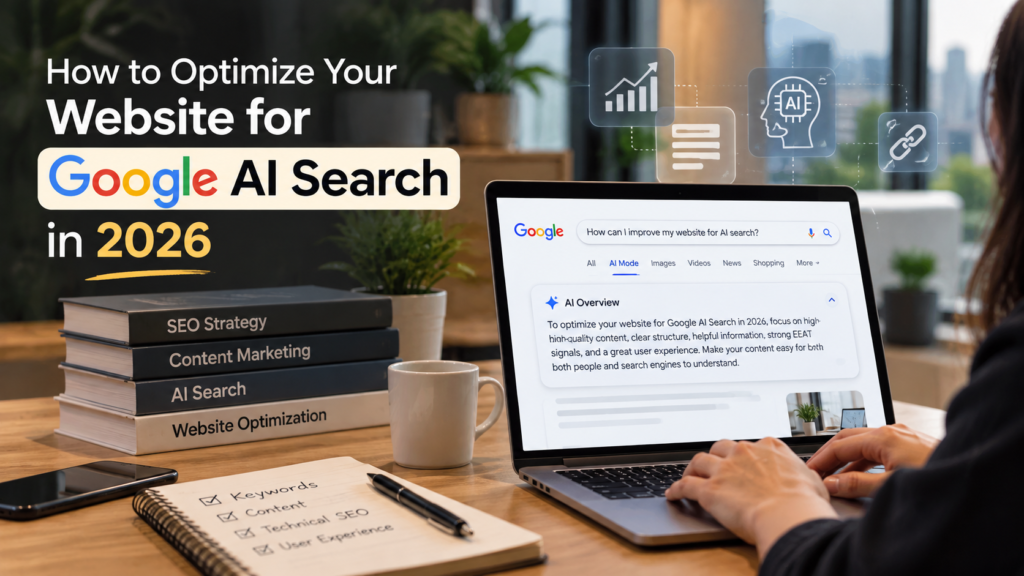
Google Search is changing quickly. People are no longer using Google only to find a list of website links. Today, search can include AI-generated answers, summaries, images, videos, maps, products, and other formats.
This change has created a common question for website owners:
How can I optimize my website for Google AI Search in 2026?
The answer is not to create content specifically for AI and forget about people. Your website still needs useful information, clear structure, strong expertise, and a good user experience.
The goal is to make your content easy for both search engines and people to understand.
Let’s look at practical ways to prepare your website for AI-driven search.
What Is Google AI Search?
Google AI Search refers to search experiences where artificial intelligence helps users understand information and find answers.
Instead of simply showing links, Google may summarize information from different sources and help users explore a topic through follow-up searches.
For businesses, this means that getting visibility in search is becoming more than just reaching the traditional top 10 results.
Your content should clearly answer questions and provide enough useful information for Google to understand:
- What your business does
- Who your content is for
- What topics you cover
- How trustworthy your information is
- What makes your business relevant to the search
This is why traditional SEO fundamentals still matter.
1. Write for People First
The first rule for AI search is surprisingly simple:
Create content that genuinely helps people.
Don’t write an article just because a keyword has search volume.
Think about what the person actually wants to know.
For example, someone searching for:
“How much does SEO cost in India?”
probably wants more than a definition of SEO.
They may want to know:
- Average pricing
- Different SEO packages
- What affects the cost
- What agencies usually include
- Whether SEO is suitable for their business
- What questions to ask before hiring an agency
A useful article should answer those questions naturally.
When content is genuinely helpful, it has a better chance of being useful across different search experiences.
2. Understand Search Intent
Search intent is still extremely important.
Before creating a page, ask:
What is the person trying to accomplish with this search?
For example:
“What is SEO?”
is mainly informational.
has commercial intent.
“Buy running shoes online”
has transactional intent.
The page you create should match that intent.
If someone searches for a service, don’t give them a 2,000-word history of the industry. Give them useful information about the service, pricing factors, process, benefits, FAQs, and how they can contact you.
Understanding intent helps you create content that actually satisfies the search.
3. Give Clear Answers to Important Questions
AI-powered search often focuses on answering specific questions.
That makes clear and direct writing even more useful.
Instead of hiding the answer inside a long introduction, provide the answer early.
For example:
How Much Does SEO Cost in India?
SEO pricing can vary depending on the business, competition, website size, target locations, and services required. Small businesses may need a smaller monthly campaign, while national and e-commerce websites generally require a larger SEO investment.
Then explain the topic in more detail.
This structure helps readers quickly find what they need while giving you space to provide useful context.
4. Use Clear Headings and Structure
A well-structured page is easier to read and easier to understand.
Use:
- One clear H1
- Relevant H2 headings
- H3 headings when needed
- Short paragraphs
- Bullet points
- Tables where useful
- FAQs
- Examples
For example:
H1: How to Get More Customers from Google Business Profile
H2: What Is Google Business Profile?
H2: Why Google Business Profile Matters
H2: How to Get More Reviews
H2: How to Improve Your Local Visibility
H2: Common Mistakes to Avoid
This gives the page a logical flow.
Don’t add headings simply because you want more keywords. Every heading should help the reader navigate the content.
5. Build Topic Depth Instead of Publishing Random Articles
A strong website should demonstrate knowledge around important topics.
For example, if your business provides SEO services, one article about SEO may not be enough.
You could create useful supporting content around:
- SEO basics
- Keyword research
- Technical SEO
- Local SEO
- Google Business Profile
- SEO pricing
- Content optimization
- Internal linking
- SEO audits
- Google rankings
These articles can then be connected through relevant internal links.
This creates a stronger content structure and helps users move naturally from one topic to another.
6. Show Real Experience and Original Information
AI can generate general information very quickly.
That means generic content is easier to produce than ever.
One way to make your content more valuable is to include things that come from your actual experience.
For example:
- Your process
- Real examples
- Case studies
- Before-and-after results
- Screenshots
- Common customer questions
- Lessons from projects
- Original research
- Industry observations
Suppose you’re writing about local SEO.
Instead of simply explaining what local SEO means, explain how you actually approach a local SEO campaign.
For example:
“We start by checking the Business Profile, service pages, location targeting, reviews, and existing local visibility before creating a content plan.”
That adds practical value that generic content often lacks.
7. Make Your Business Information Easy to Understand
If you are optimizing a website for a business, don’t make Google guess what the company does.
Clearly explain:
- Business name
- Services
- Products
- Locations
- Target customers
- Contact information
- Areas served
- Business experience
Create dedicated service pages when appropriate.
For example, a digital marketing agency might have separate pages for:
- SEO Services
- Social Media Management
- Google Ads Management
- Content Writing
- Website Development
Each page should explain the specific service instead of putting everything on one generic page.
8. Strengthen Your Internal Linking
Internal links help users discover related information on your website.
They also help search engines understand the relationship between different pages.
For example, an article about SEO pricing in India could naturally link to:
SEO Services in Delhi NCR
An article about Google Business Profile could link to:
Local SEO Services
The important thing is relevance.
Don’t add ten internal links just because you can.
Ask yourself:
Will this link help the reader understand the topic or take the next useful step?
If the answer is yes, the link probably makes sense.
9. Keep Important Pages Updated
SEO is not only about creating new pages.
Your existing pages also deserve attention.
If a page contains information that has changed, update it.
Check:
- Statistics
- Pricing
- Screenshots
- Examples
- Links
- Services
- Business information
- Outdated recommendations
But don’t update an article simply to change the date.
Make meaningful improvements that make the page more useful.
An old article can sometimes have valuable search visibility, backlinks, or useful information that is worth preserving and improving.
10. Improve Website Experience
Great content won’t be enough if your website is difficult to use.
Make sure your website:
- Loads properly
- Works well on mobile
- Has readable text
- Uses clear navigation
- Doesn’t overwhelm visitors with pop-ups
- Has accessible buttons
- Uses descriptive links
- Makes important information easy to find
Think about the experience from the visitor’s perspective.
Someone should be able to land on your page and quickly understand:
What is this page about?
Can this business help me?
Where can I find more information?
What should I do next?
11. Use Different Content Formats
Search is becoming more visual and interactive.
Depending on your topic, consider adding:
- Original images
- Infographics
- Videos
- Screenshots
- Charts
- Tables
- Step-by-step guides
- FAQs
For example, a blog explaining how to set up Google Business Profile could include a simple step-by-step graphic.
A technical SEO article could include screenshots.
A case study could include charts showing progress.
The format should match the topic.
Don’t add images just to make the page look longer.
12. Make Your Content Easy to Quote and Understand
If your page contains useful information, make important points clear.
Instead of writing one huge paragraph containing several ideas, separate them.
For example:
What Is Local SEO?
Local SEO is the process of improving a business’s online visibility for searches connected to a specific location.
Then explain how it works.
Clear writing helps readers understand the page quickly and makes individual sections easier to interpret.
13. Use FAQs Carefully
FAQs can be useful when they answer genuine questions your audience has.
For example, an SEO service page could answer:
How long does SEO take?
How much does SEO cost?
Does SEO work for small businesses?
What is included in an SEO package?
Don’t create dozens of questions just to add keywords.
Choose questions that customers actually ask.
Your sales team, customer support conversations, search queries, and existing website data can be excellent sources for finding these questions.
14. Build Trust Around Your Content
People want to know whether the information they are reading is reliable.
Make your website more trustworthy by clearly showing:
- Who created the content
- Business information
- Contact details
- Author information where appropriate
- Relevant experience
- Case studies
- Customer reviews
- Original examples
- Clear service information
If you’re giving professional advice, make sure the content is reviewed carefully before publishing.
The goal is to make visitors feel that there are real people and real expertise behind the website.
15. Don’t Try to “Trick” AI Search
There will always be shortcuts claiming to help websites appear in AI search.
Be careful with them.
Don’t fill pages with unnatural keywords.
Don’t create hundreds of nearly identical location pages.
Don’t copy competitor content and change a few words.
Don’t publish meaningless AI-generated articles simply to increase the number of pages on your website.
Instead, focus on a simple question:
“Does this page give the user something genuinely useful?”
If the answer is no, adding more keywords probably won’t fix the problem.
How to Prepare Your Website for Google AI Search
A practical workflow can look like this:
Step 1: Identify your important topics
Start with the products, services, and questions that matter to your customers.
Step 2: Research search intent
Understand what users want from each search.
Step 3: Improve existing pages
Before creating new content, check whether you already have pages that can be improved.
Step 4: Create useful supporting content
Answer related questions and cover important subtopics.
Step 5: Add original value
Include your experience, examples, data, case studies, and insights.
Step 6: Connect your pages
Use relevant internal links to create a logical website structure.
Step 7: Improve user experience
Make your website fast, readable, mobile-friendly, and easy to navigate.
Step 8: Monitor actual performance
Look at search visibility, clicks, traffic, conversions, enquiries, and other meaningful business results.
Final Thoughts
Optimizing for Google AI Search in 2026 does not require a completely different version of SEO.
The fundamentals still matter.
Your website needs to be useful, well-structured, technically sound, trustworthy, and relevant to what people are searching for.
The bigger change is that search is becoming more conversational and more focused on answering questions directly.
That means businesses should move away from writing content simply to target keywords and start creating content that actually solves problems.
Think beyond:
“How do I rank this keyword?”
Instead, ask:
“What does my customer want to know, and how can my website give them the best answer?”
Use clear content, strong service pages, relevant internal links, original experience, useful visuals, and a website that is easy to navigate.
Most importantly, don’t try to create content for AI alone.
Create genuinely useful content for people first.
When your website clearly demonstrates what you know, what you offer, and how you can help, you give both users and modern search systems a much better understanding of your business.